Advancing Early Diagnosis and Treatment of Alzheimer’s Disease (AD) and Mild Cognitive Impairment (MCI): Integrating Biomarkers, Imaging, Diagnostics, and Therapeutics
Welcome! The first ACCME-accredited CME experience delivered in Virtual Reality (VR), offering up to 1.0 AMA PRA Category 1 Credit™ through the UAB Heersink School of Medicine.
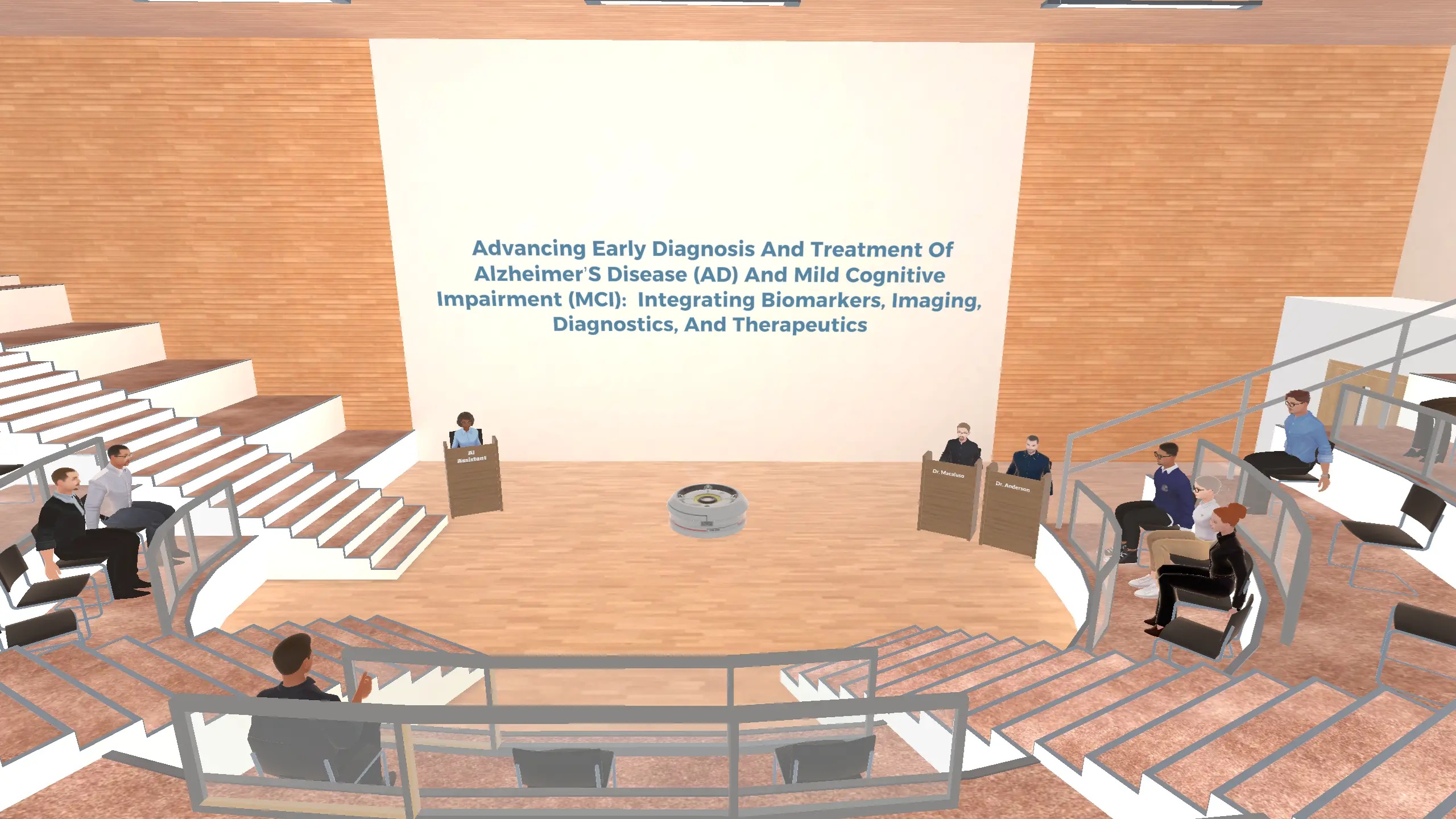
Advancing Early Diagnosis and Treatment of Alzheimer’s Disease (AD) and Mild Cognitive Impairment (MCI): Integrating Biomarkers, Imaging, Diagnostics, and Therapeutics
Activity Details
Activity Title: Advancing Early Diagnosis and Treatment of Alzheimer’s Disease (AD) and Mild Cognitive Impairment (MCI): Integrating Biomarkers, Imaging, Diagnostics, and Therapeutics
Format: Interactive VR/Online Enduring Activity with integrated knowledge checks
Estimated Time to Complete: 45–60 minutes
Release Date: May 8, 2026
Expiration Date: May 8, 2027
Fee: None
Provider: UAB Division of Continuing Medical Education, in collaboration with EmbodyXR, Inc.
Credit Designation:
The University of Alabama Heersink School of Medicine designates this activity for a maximum of 1 AMA PRA Category 1 Credit™.
Accreditation Statement
To improve patient care, this activity has been planned and implemented by the UAB Marnix E. Heersink School of Medicine and EmbodyXR. The UAB Marnix E. Heersink School of Medicine is jointly accredited by the Accreditation Council for Continuing Medical Education (ACCME), the Accreditation Council for Pharmacy Education (ACPE), and the American Nurses Credentialing Center (ANCC) to provide continuing education for the healthcare team.
Program Distinction and Study Integration
This activity represents the first ACCME-accredited CME program delivered in a Virtual Reality (VR) modality, establishing a new benchmark for immersive, evidence-based medical education. It is also the inaugural UAB CME VR Learner Case Study, designed to rigorously evaluate educational effectiveness across learning modalities.
The program clearly communicates first ACCME VR CME delivery, research rigor, and real-world clinical impact, through a structured comparison of:
- Immersive VR-based learning (headset experience)
- Traditional online CME (PC/web-based formats)
Educational content is standardized across modalities to ensure methodological integrity and enable valid comparison of knowledge acquisition, retention, clinical reasoning, and intended practice change.
Target Audience
This activity is designed for healthcare professionals involved in the identification, evaluation, and management of cognitive impairment and neurocognitive disorders, including:
Primary care clinicians
Geriatricians and geriatric care teams
Nurses, nurse practitioners, and physician assistants
Neurologists and psychiatrists
Neuroradiologists and radiologists
Other clinicians supporting diagnostic evaluation, treatment planning, and longitudinal care
Educational Need and Practice Gap
In clinical practice, Alzheimer’s disease and MCI are frequently under-recognized in early stages, and care pathways vary across settings. Key needs include:
Inconsistent use of validated cognitive screening tools
Limited integration of blood-based biomarkers with imaging and clinical staging
Variability in familiarity with therapeutic eligibility, monitoring requirements, and safety considerations
Lack of practical, stepwise pathways to guide timely diagnosis, referral, treatment planning, and follow-up
Learning Objectives
After completing this activity, learners will be able to:
Use validated cognitive screening tools (Mini-Cog™, MoCA) with appropriate administration and interpretation
Integrate blood-based biomarkers (p-tau217, p-tau231, Aβ42/40) with MRI findings and clinical assessment
Differentiate anti-amyloid DMTs (lecanemab vs donanemab), including mechanism, use, and ARIA risk recognition
Apply the NIA-AA biomarker framework to diagnostic reasoning and patient selection
Implement a practical clinical pathway: screening → biomarker confirmation → treatment selection → monitoring and follow-up
Faculty
Matthew Macaluso, DO
Bee McWane Reid Professor; Vice Chair of Clinical Affairs, Department of Psychiatry, Heersink School of Medicine, UAB
Allan Anderson, MD
Board-certified Geriatric Psychiatrist; Former Medical Director, Toole Family Memory Center, Banner Alzheimer’s Institute
Full faculty biographies are available on the Faculty page.
Instructional Design and Format
This enduring activity is designed for clinical workflow relevance and immediate applicability, using:
Case-based instruction aligned to real-world diagnostic and treatment decisions
Integrated knowledge checks throughout the activity
Pre-test and post-test to measure knowledge acquisition and learning impact
Standardized content across VR and PC formats to support study integrity and comparability
The immersive VR modality enhances spatial understanding, engagement, and retention, while maintaining strict alignment with evidence-based educational design.
Credit and Claiming Instructions
To claim AMA PRA Category 1 Credit™, learners must:
Complete the pre-test
Complete all instructional modules
Achieve a post-test score of ≥80%
Complete the post-activity evaluation
Standards for Integrity and Independence (ACCME)
This activity complies with ACCME Standards to ensure:
Scientifically rigorous, evidence-based, and balanced content
Independence from commercial influence
Disclosure and mitigation of financial relationships
Transparency regarding investigational or off-label use
Commercial Support
No commercial support was provided for this activity unless otherwise noted.
Off-Label / Investigational Use
No off-label or investigational content is included in this activity.
Accessibility (ADA)
UAB CME complies with ADA requirements. Reasonable accommodations are available upon request.
Privacy and Data Use
Learner data is used solely for accreditation, outcomes measurement, and quality improvement in accordance with UAB CME policies. No protected health information (PHI) is included in educational content.
UAB CME Virtual Reality (VR) Learner Case Study
Overview
This CME activity serves as the UAB CME VR Learner Case Study, establishing a repeatable, research-informed model for immersive CME delivery. Learners are assigned to VR or traditional formats to enable controlled comparison using consistent educational content and standardized evaluation methods.
Purpose and Study Rationale
Research and Innovation
Establishes a scalable framework for VR-based CME and simulation-driven education
Evaluates immersive learning against traditional CME delivery
Generates evidence to inform accreditation standards and future educational design
Clinical Education Impact
Supports frontline clinicians with practical, guideline-aligned decision-making
Strengthens early recognition, diagnostic accuracy, and treatment planning
Translates specialist expertise into broadly accessible clinical education
Patient Outcomes and Practice Change
Promotes routine use of validated cognitive screening tools
Reduces missed or delayed identification of cognitive impairment
Reinforces structured pathways from diagnosis to treatment and follow-up
Supports more consistent and equitable care delivery
Dissemination and Field Advancement
Findings are intended for publication to inform CME providers, health systems, and accrediting bodies
Expands access to specialist-informed education beyond academic centers
Contributes to emerging standards for VR-enabled CME design, delivery, and outcomes measurement
Participant Groups
Primary Target Audience (Frontline Care)
Primary care clinicians
Geriatric physicians and care teams
Physician assistants
Specialist Participants
Neurologists
Psychiatrists
Neuroradiologists and radiologists
Subspecialists supporting diagnostic evaluation and treatment planning
Participant Assignment and Program Pathways
VR Headset Participants
Assigned to complete the immersive VR experience and included in formal study analysis
PC-Based Participants
Assigned to complete traditional CME formats and included in comparative analysis
Optional Post-Program VR Experience
PC participants may access a separate VR experience focused on cognitive screening skills; this is not included in the formal study analysis
Completion Criteria
Completion of pre-test, all modules, post-test (≥80%), and activity evaluation is required to claim ACCME credit
Outcomes Measurement Plan
Moore’s Levels
Levels 1–2: Participation and satisfaction
Level 3: Knowledge gain
Level 4: Competence and intent-to-change practice
Advanced Data Capture
Free-text learner reflections
AI-assisted summarization and thematic analysis
De-identified insights used for outcomes reporting and continuous improvement
Participant Support and Key Contacts
CME Administration and Credit Support
Ronan O’Beirne, EdD, MBA
Director, Division of Continuing Medical Education, UAB
Program and Platform Support (EmbodyXR)
Sean Moloney
CEO/Co-Founder, EmbodyXR, Inc.
On-Site VR Coordination (Heersink Institute XR + AI Lab)
Heather Milam, MPPM — Administrative Director
Hannah VanSlambrouck, MBA — Program Director II
Abhiraj Pudhota, BS, PSM — Bioinformatician I | Project Manager